

From Research and Intellectual Property to Ventures, Capital and Global Scale
Why the next chapter of Swiss innovation depends on connecting research, entrepreneurial talent, corporates, investors and markets.
The world does not lack innovation. It needs more innovation that reaches the market.
Switzerland has built an international reputation for scientific excellence, engineering, research and technological innovation. Its universities, research institutions, multinational corporations, startups and investors create an environment where ambitious ideas can emerge and develop.
The Lausanne region is a particularly compelling example of this strength.
As an Ambassador of Innovaud, the innovation and investment promotion agency of the Canton of Vaud, I see the importance of connecting the different parts of this ecosystem and helping create the conditions for innovation to grow beyond its point of origin.
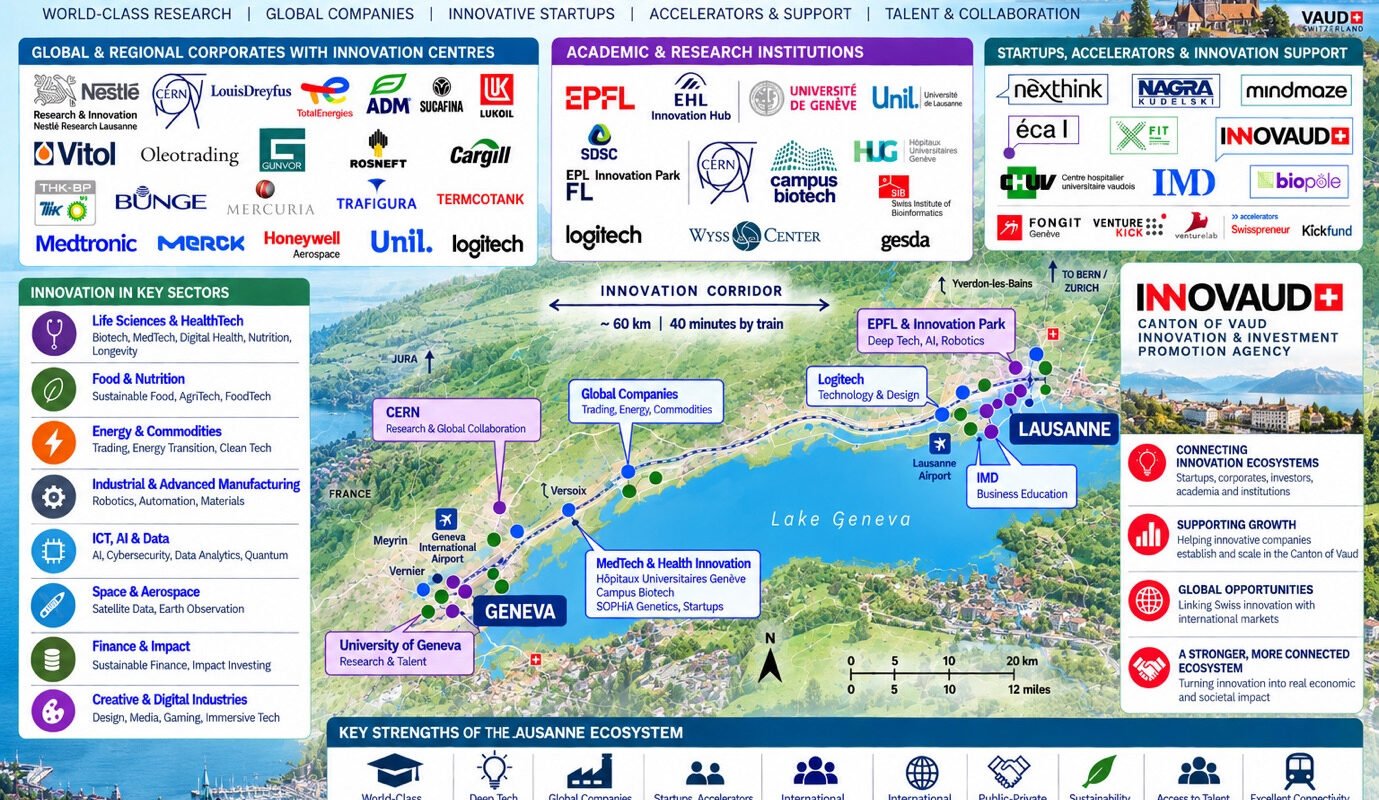
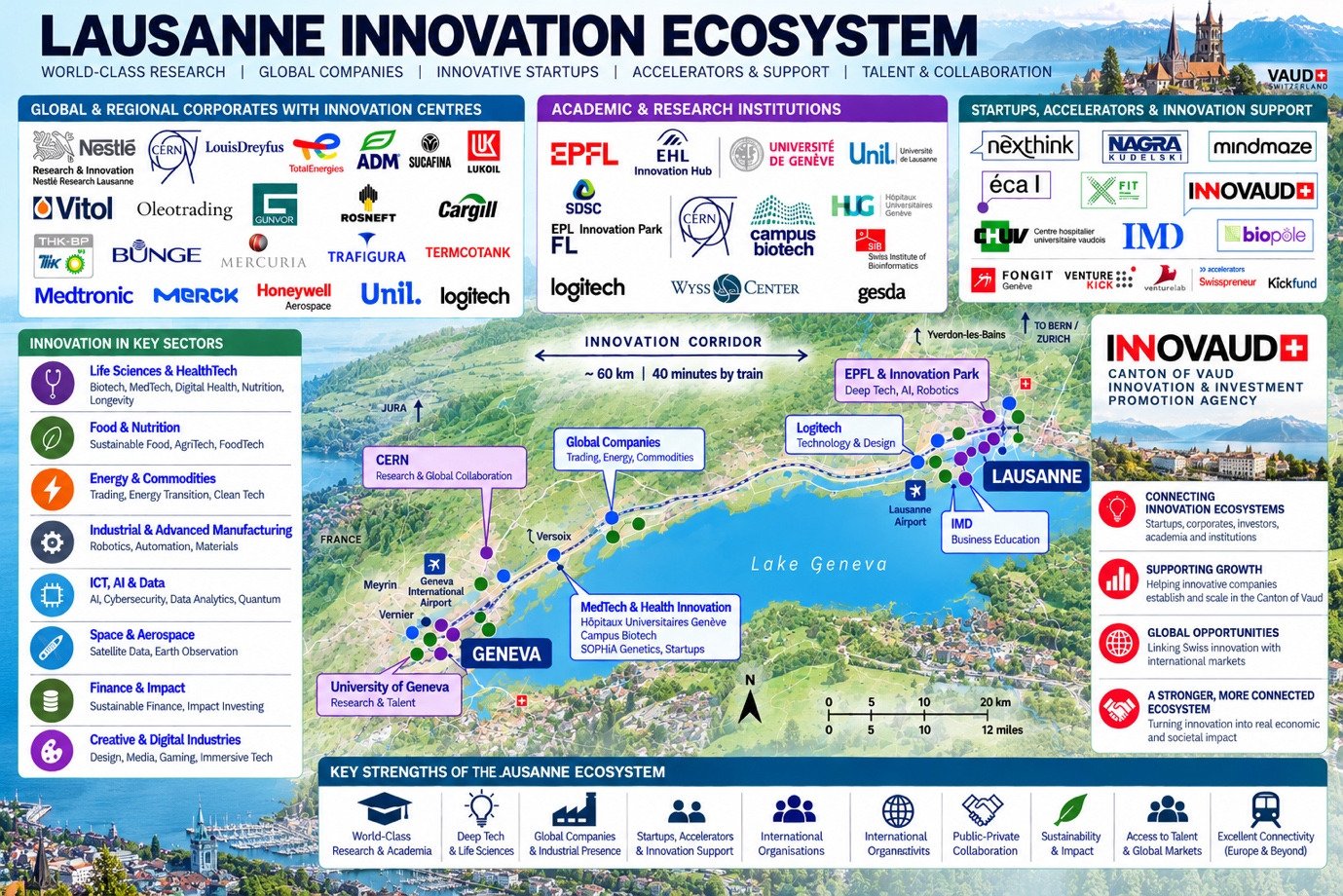
The Greater Lausanne corridor brings together research institutions, global companies, entrepreneurs, investors and specialised innovation hubs. It offers a strong foundation for developing technologies that can address meaningful challenges across industries and international markets.
How do we convert outstanding research and intellectual property into commercially validated, investable and globally scalable businesses?
The answer requires us to look beyond research funding, startup competitions, accelerators and company formation. It requires us to focus on the entire journey from innovation to commercialisation.
The opportunity is to build the capability to repeat that journey successfully.
1. Lausanne: An ecosystem of interconnected capabilities
One of the defining strengths of the Canton of Vaud is the combination of capabilities available within a relatively connected region.
Research institutions and universities generate scientific knowledge, intellectual property and highly skilled talent. Corporates bring industry expertise, technical challenges, infrastructure and potential customers. Investors provide capital, while entrepreneurs and business leaders turn opportunities into ventures.
These capabilities are complemented by government and institutional support, international connectivity and access to regional and global markets.
The Lausanne Innovation Ecosystem is therefore more than a collection of successful organisations. Its greater potential lies in the relationships between them.
The region includes internationally recognised institutions such as EPFL and the University of Lausanne, alongside major companies, research centres, startups and specialist innovation communities.
Global companies such as Nestlé, Logitech, Medtronic, Merck and Honeywell illustrate the breadth of industrial and technological activity associated with the wider region. Each operates in markets where research, engineering, product development and commercial execution can play important roles.
However, the presence of these capabilities does not automatically create successful businesses. The real opportunity is to make the connections between them more productive: connecting promising research to industry problems, entrepreneurs to intellectual property, startups to early customers, and investment capital to commercially credible opportunities.
The strength of an innovation ecosystem is not measured only by what it produces, but also by how effectively its different participants work together.
2. Innovaud and the importance of connected innovation hubs
Innovation rarely happens in isolation. It develops through interactions between people, institutions, companies, technologies and markets.
In the Canton of Vaud, Innovaud actively collaborates with technology parks and innovation hubs that bring different capabilities and communities together. These include:
1.Agropôle connecting innovation with agriculture, food and related industries.
2.Ateliers de Renens contributing to the region’s entrepreneurial and innovation
environment.
3.Biopôle a major life sciences and health innovation campus.
4.EPFL Innovation Park connecting technology companies, research and
entrepreneurship.
5.Technopôle de Sainte-Croix supporting technology and industrial innovation.
6.Y-PARC an innovation and technology park in Yverdon-les-Bains.
7.Swiss Aeropole a specialised environment for aerospace and aviation-related
activities.
8.Unlimitrust a campus focused on trust technologies and digital trust.
Each hub has its own identity, areas of expertise and community. Collectively, they contribute to a broader environment where startups, corporations, investors, academics, institutions and other stakeholders can engage with one another. This collaborative approach matters because innovation increasingly crosses traditional sector boundaries.
Life sciences can intersect with data and artificial intelligence. Industrial engineering can benefit from robotics and advanced computing. Agriculture and food systems can draw on biotechnology and sustainability. Cybersecurity and digital trust can become essential foundations for the adoption of new technologies.
An interconnected ecosystem makes it easier to identify these opportunities and bring the relevant participants together.
As an Innovaud Ambassador, I see this connected approach as an important part of the Canton of Vaud’s proposition to innovators and businesses looking for a supportive environment in which to develop and grow.
The next opportunity is to build on these connections so that collaboration leads not only to knowledge exchange, but also to commercial partnerships, customer validation and new ventures.
3. The missing link: From research to commercially viable businesses
Traditional innovation ecosystems often have clearly defined participants.
Researchers develop technologies and intellectual property. Universities support research and spinouts. Accelerators help startups develop their propositions. Investors provide capital. Corporations have industry challenges, infrastructure and customers. Yet these activities can remain fragmented.
A promising technology may have strong scientific foundations without a clearly defined market. A research team may understand the technology but lack the commercial leadership needed to build a business. An investor may recognise the potential but be unable to identify a team capable of executing the opportunity.
A corporation may have a problem that new technology could solve, but lack a straightforward route to discovering and adopting the right solution.
Who brings these elements together and does the hard work of building the company?
This is where connecting the ecosystem becomes important. Building a business is not simply the process of incorporating a company or helping an existing startup prepare a pitch. It is a structured approach to identifying promising opportunities, validating markets, assembling teams, creating ventures, securing early customers and preparing businesses for growth.
For deep-tech ventures, this can be especially important. Complex technologies may require significant development, specialised talent, industry partnerships and a longer path to commercial validation.
The missing layer is therefore not simply more funding. It is the capability to turn promising intellectual property into repeatable, commercially viable ventures.
4. Why building a business is different from funding or acceleration
A fund invests capital. An accelerator helps founders develop their businesses. An innovation park provides an environment for companies and institutions to interact.
A venture builder can connect these activities through direct involvement in the creation and development of businesses. The distinction is important.
The objective is not to assume that every promising technology should become a startup. It is to determine which technologies address meaningful problems, which markets are ready to adopt them, what capabilities are needed to build the business, and how the venture can establish a sustainable commercial model.
Building a business has several stages:
First, identify the opportunity. Source promising intellectual property from universities, research institutions, scientists, engineers and technology founders.
Second, validate the market. Determine whether the technology addresses a real customer problem, whether customers are willing to adopt it, and whether a commercially attractive market exists.
Third, find the builders. Match the opportunity with entrepreneurs, engineers, product leaders, commercial executives and industry specialists who can build the business.
Fourth, create the business. Establish the company around a defined market opportunity, a credible founding team, appropriate intellectual property arrangements and a clear commercial thesis.
Fifth, mobilise early capital. Bring together private investors, high-net-worth individuals, family offices, strategic partners and other appropriate sources of pre-seed funding.
Sixth, engage corporates and institutions. Secure access to pilots, laboratories, infrastructure, industry expertise, partnerships and potential customers.
Seventh, prove commercial viability. Move beyond technical proof-of-concept towards customer validation, revenue and repeatable sales.
Finally, prepare for scale. Connect the venture to institutional capital, international customers, strategic partners and new markets.
This is an integrated process, not a guarantee of success. Technologies will still fail, markets will change and investment decisions will involve risk. But a structured approach can help identify problems earlier, direct resources more effectively and give promising technologies a clearer route towards commercial success.
5. The most important resource may be the founders
Capital is essential, but capital alone does not build companies.
One of the challenges is finding talented people who can translate complex scientific and technical innovation into businesses that customers understand, adopt and pay for.
A scientist may develop a breakthrough technology without wanting to become a full-time entrepreneur. An experienced founder may have the commercial capabilities but lack access to the right intellectual property. A corporate executive may understand the market but not know where to find emerging technologies.
The ecosystem needs ways to bring these capabilities together. Lausanne has an opportunity to develop a broader network of entrepreneurs, bringing together:
1.Scientists and researchers who understand the underlying technology.
2.Engineers and product leaders who can turn concepts into usable solutions.
3.Entrepreneurs who can establish and lead new businesses.
4.Commercial leaders who understand customers, distribution and sales.
5.Industry experts who can validate real-world applications.
6.Investors who can support the venture through different stages of development.
This approach expands the traditional idea of entrepreneurship.
Instead of assuming that every researcher must become a founder, it creates opportunities for complementary teams to form around promising technologies. We have exceptional founder success story in Switzerland and we seek to develop a repeatable capability for building companies.
Technology creates possibility. Entrepreneurs create companies. Customers create validation. Capital enables scale.
The connections between these elements can become a lasting source of competitive advantage.
6. Making corporates active participants in innovation
Large companies can play a much greater role in venture creation than simply sponsoring innovation programmes or investing in startups.
They understand industry problems, customer needs, regulatory requirements, supply chains and the practical constraints of deploying new technologies.
Their participation can help answer an essential question much earlier in the venture-building process: who needs this technology, and why would they adopt it?
Corporate engagement can take several forms, including defining industry challenges, providing access to test environments, participating in pilots, becoming early customers, offering technical expertise and forming strategic partnerships.
For example, a deep-tech company developing an industrial solution may need access to operational environments before it can demonstrate commercial value. A health technology venture may need to establish clinical relevance, regulatory feasibility and a credible route to adoption. An enterprise software company may need a corporate partner willing to test the product against a real business problem.
These relationships help bridge the gap between a technology that works and a product that a market is ready to buy. The objective is not to make every startup dependent on a large corporate. It is to create more practical pathways through which promising innovations can be tested, refined and adopted.
For Lausanne, a strong combination of research institutions, global companies, startups and specialist innovation hubs provides a foundation for deeper collaboration.
The opportunity is to make industry demand an active part of the innovation process from the beginning.
7. Rethinking the role of capital
Investors are often presented with opportunities in the form of technologies, research breakthroughs or ambitious market projections.
But an investable technology is not necessarily an investable business.
Investors need to understand the customer problem, the market opportunity, the competitive position, the intellectual property, the team, the route to revenue and the capital required to achieve the next meaningful milestone.
Commercialisation can help connect these elements. Instead of asking investors simply to fund a promising technology, the proposition becomes one of building a commercially validated business around it.
This can create a more structured pathway for private investors, family offices, strategic investors and institutional funds to assess opportunities.
Early-stage capital can support technology and market validation, team formation and initial commercial development. Corporate partnerships can provide access to industry expertise and potential customers. Later investment with growth capital can support expansion when the business has established stronger evidence of demand and execution.
This does not remove investment risk or guarantee returns. It creates a clearer framework for understanding what capital is intended to achieve at each stage.
The goal is to connect capital with milestones that matter: validated demand, capable teams, customer adoption, revenue and the potential for sustainable growth.
8. Building an innovation flywheel
A successful innovation ecosystem should become stronger as the innovation cycle connects the ecosystem.
Consider a simple cycle of Intellectual property → Talent → Venture → Customer → Capital → Scale → New intellectual property
A promising technology attracts entrepreneurial talent. The team builds a venture and validates its offering with customers. Evidence of commercial progress attracts further capital and strategic partnerships. If the business scales successfully, it can create new opportunities for employees, founders, investors and the wider ecosystem.
Successful founders may become mentors or investors. Experienced executives may join new ventures. Corporates may become more willing to work with startups. Investors may develop greater confidence in the region’s venture-building capabilities. Research institutions may see more pathways for translating their work into commercial impact.
Over time, this can create a self-reinforcing system rather than a collection of disconnected programmes. The objective is not merely to produce more startups. It is to increase the ecosystem’s capacity to develop sustainable companies, learn from experience and reinvest that experience in future ventures.
9. Why Lausanne can be a strategic gateway to global markets
Lausanne should not be viewed only as a place to establish a company. Its potential is broader: it can serve as a strategic node connecting Swiss research and intellectual property with capital, entrepreneurial talent, corporate partners and international markets.
Switzerland offers a strong foundation in research, science, engineering and deep-tech innovation. The Canton of Vaud adds access to a connected business environment, international networks, regional markets and a diverse innovation community.
However, a successful global venture will not necessarily find every capability it needs in one country.
Its best customers may be elsewhere. Its manufacturing partners may be in another market. It may need specialist talent from several countries, international capital or access to infrastructure beyond Switzerland.
This is why a cross-border approach can be more powerful than a single-country model. Rather than expecting one ecosystem to provide everything, a network of complementary ecosystems can connect the strongest combination of intellectual property, talent, capital, customers and infrastructure for each opportunity.
Lausanne can be a starting point for this model, linking Swiss innovation capabilities with partners and markets internationally.
The ambition is to make cross-border collaboration a practical route to company building and commercialisation, not simply an exchange of contacts or introductions.
10. From ecosystem promotion to ecosystem execution
Innovation parks, universities, investors, corporates and public institutions each make valuable contributions. Their impact can become greater when their activities are connected through a shared commercial objective.
Research institutions contribute science, intellectual property and talent.
Universities provide research capabilities, laboratories and opportunities for spinouts.
Corporates contribute industry problems, expertise, pilots and potential customers.
Private investors and family offices can provide early risk capital.
Institutional investors can support later growth and expansion.
Governments and institutions help create the policy environment, infrastructure and support mechanisms in which innovation can develop.
Venture builders connect these capabilities through company creation, market validation, commercialisation and execution.
This does not mean replacing existing organisations or programmes. It means strengthening the connections between them and identifying where additional capabilities are needed.
For Innovaud and the wider Canton of Vaud ecosystem, continued dialogue between startups, corporations, investors, academics, institutions and innovation hubs is an important foundation.
The next opportunity is to translate more of that collaboration into tangible commercial outcomes: stronger industry partnerships, better access to early customers, new ventures built around valuable intellectual property, and clearer routes to international markets.
11. A vision for the next chapter of Swiss innovation
The ambition should be bigger than creating another fund, launching another accelerator or incorporating another group of technology companies.
It should be to develop the capability and infrastructure that repeatedly converts promising innovation into globally scalable businesses.
That requires a disciplined approach:
1.Source intellectual property with genuine potential to solve important problems.
2.Find the builders who can combine technical expertise with entrepreneurial and
commercial leadership.
3.Validate markets before committing to large-scale expansion.
4.Build ventures around credible teams, customers and commercial opportunities.
5.Mobilise capital in line with the milestones and risks of each stage.
6.Connect industry through pilots, partnerships and early adoption.
7.Scale globally by accessing the right customers, talent, partners and markets.
No single organisation can deliver this alone. The opportunity depends on collaboration across the ecosystem, with each participant contributing its strengths to a shared process.
As an Innovaud Ambassador, I have seen Canton of Vaud playing an important role in strengthening these connections and promoting an environment where innovation can move from research to market.
Lausanne is not the destination for every venture. It can, however, become a powerful starting point for businesses that combine Swiss innovation with global ambition.
Innovation is a journey. Commercialisation is where its value is realised.
The Lausanne Innovation Ecosystem demonstrates the importance of bringing research, industry, talent, capital and institutions into closer collaboration.
Its innovation hubs, universities, research institutions, startups and corporate communities provide a strong foundation. The opportunity ahead is to connect these strengths more systematically with venture creation, customer validation and international expansion.
The central lesson is straightforward.
The missing layer is not simply more capital. It is the capability to turn promising intellectual property into repeatable, commercially viable ventures.
Switzerland can provide a powerful gateway for research, intellectual property, science and engineering. Lausanne and the Canton of Vaud can help connect these strengths with builders, corporates, investors and markets.
Together with complementary international ecosystems, this can provide a foundation for a more connected approach to venture building and global commercialisation.
The ultimate measure of success will not be the number of research breakthroughs, innovation programmes or startups alone. It will be the number of meaningful innovations that reach customers, build sustainable businesses and create lasting economic value.
The question for all of us working in innovation is this: How do we move from creating more promising technologies to building the capability to create more successful global businesses?
That is the opportunity worth pursuing.
With over 35 years in business and as an Ambassador of Innovaud, the innovation and investment promotion agency of the Canton of Vaud, Switzerland. I love founders and support entrepreneurs, commercialisation, cross-border innovation and connecting founders, investors, corporates and ecosystems to see businesses scale internationally.